-
Essential:
Essential cookies are essential for you to browse the website and use its features. Cookies that allow web shops to hold your items in your cart while you are shopping online and navigating the website are an example of strictly necessary cookies. Our website does not work without these cookies, so they are stored without your express consent.
-
Preferences cookies:
Preferences cookies can be used to change the user experience of our website. Preferences cookies allow a website to remember choices you have made in the past.
-
Statistics cookies:
Statistics cookies are used to collect information about how you use our website. None of this information can be used to identify you.
-
Marketing cookies:
Marketing cookies track your online activity. The purpose of marketing cookies is to help advertisers deliver more relevant advertising or to limit how many times you see an ad.
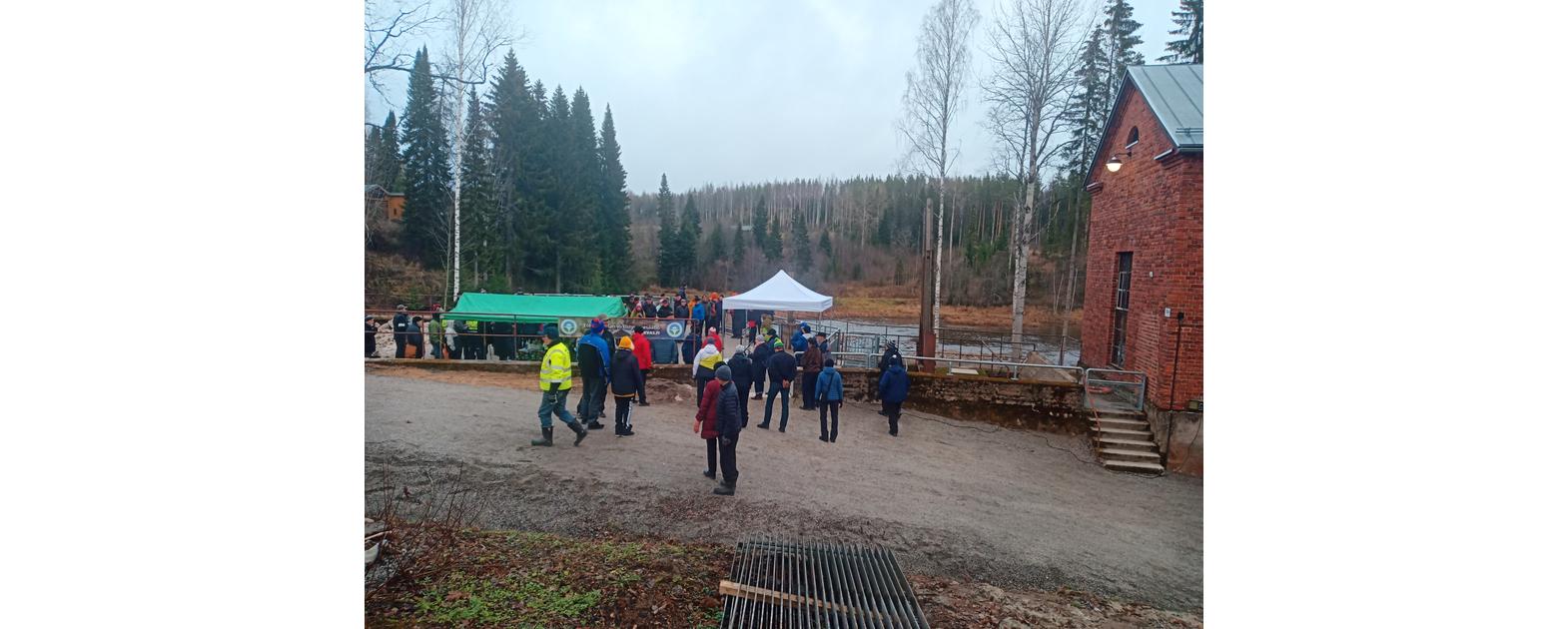
Visitors at the Public Day in Kangaskoski on 20.11.2021
IN THE BORDERLANDS OF THE OLD AND NEW HIITOLANJOKI RIVER
The Hiitolanjoki River, still known as the Kokkolanjoki River, has received much attention this year. Its public profile rose again approximately three years ago when the stalemate, which had lasted for years concerning the implementation of an alternative use for the rapids developed for hydropower, finally began to break.
First, the South Karelia Recreation Area Foundation managed to purchase the Lahnasenkoski rapids. The year before last, a decisive breakthrough was achieved when the upstream and downstream Rita and Kangaskoski rapids were similarly acquired. Now, Kangaskoski is the first of these to be restored, meaning it has been made free-flowing and re-stoned to near its natural state for migratory fish, especially Ladoga salmon.
The ascent of salmon to the upper reaches of the Hiitolanjoki River ceased in 1911, when the Lahnanen dam and hydropower plant were completed. This was followed by an intense fifteen-year phase of industrial hydropower expansion, during which the river's significant rapids were harnessed. As a final act, in 1948, another hydropower plant was erected at Juvankoski in the Simpele factory area, where, however, electricity had been temporarily generated for direct-drive grinders as early as the 1890s, and then hydropower. Now, that too has ceased operation.
What does this change in a situation that has lasted over a hundred years, and which will also lead to the liberation of the Lahnasenkoski and Ritakoski rapids in the coming years, mean for the Hiitolanjoki River now? At the very least, it means that the basic prerequisites for other uses of the flowing water have been restored. This 'other use' has, of course, changed over more than a hundred years. For example, log driving and water transport are already history.
However, fishing and movement in the water system, both for fish and humans, have, despite changes in their nature, remained as forms of use for the Hiitolanjoki River to this day. In the changed situation, the resource of naturally reproducing valuable fish must be examined even more closely.
Firstly, the strengthening and stabilization of the fish stock is a necessity before large-scale recreational fishing and its tourism marketing can begin. This also involves rectifying an obvious shortcoming and deficiency: the total count of migratory fish in the Hiitolanjoki River, meeting the criteria of scientific research, must finally be carried out. Only with this can further actions be justified.
The future also offers interesting opportunities for activities alongside fishing. Underwater photographers of salmon and trout have visited the site for years, and most recently, experiences have come from the popular WWF Nature Live underwater camera. Monitoring the early summer ascent phase and, on the other hand, late autumn spawning would be a valuable idea for development, perhaps using a hybrid model where part of this would be implemented on site at special viewing spots, and part in virtual viewing rooms and via remote connections. Presenting the fish fauna and other aquatic nature, for example, for educational and tourism purposes, is one thread in the Hiitolanjoki River's new current, but not the only one. Canoeing and even just floating in the river water are also rewarding. Options range from quick visits and short day trips to long water treks starting from the Hiitolanjoki River, all the way across the watershed to Lake Saimaa.
The navigability of the restored rapids remains to be seen, but this naturally holds value for enthusiasts, which should always be considered in advance during restoration work. An even more significant matter in water transport, which would already equate to a breakthrough in fish migration, would be a special border crossing by water along the Hiitolanjoki River.
While one should never expect this to be comparable to official land border crossings, the clarification of agreement conditions, a Finnish-Russian annual quota, and group permits should absolutely be sought well in advance, within some timeframe. However, this would likely be the biggest draw, raising the Hiitolanjoki River's tourism offering to an entirely new level.
A key question for the coming years, concerning the future of the rapids areas, is what will happen to the now decommissioned power plant buildings and dam environments. At Kangaskoski, the goal of a power plant museum has already been staked out, with added value provided by the former factory island supplemented with augmented reality content. However, silent plants do not easily become exhibition sites comparable to operational ones. Here, as with the upper rapids, the challenge of change is how to transform power plants originally designed for an entirely different purpose—production—into new spaces and how to turn the activities around them into tourism revenue. What new content can be offered? Can a rapids-side restaurant even be established somewhere?
Creativity, cooperation, and benchmarking are therefore needed. New roles or at least clarification of tasks are also being sought by those who have long been involved with the river, from associations to foundations and the municipality. Entrepreneurs and businesses are ultimately significant practical implementers in Hiitolanjoki as well, but they cannot achieve everything alone. A flowing river is always an entity of many contributing factors.
-Borderlands Master