-
Essential:
Essential cookies are essential for you to browse the website and use its features. Cookies that allow web shops to hold your items in your cart while you are shopping online and navigating the website are an example of strictly necessary cookies. Our website does not work without these cookies, so they are stored without your express consent.
-
Preferences cookies:
Preferences cookies can be used to change the user experience of our website. Preferences cookies allow a website to remember choices you have made in the past.
-
Statistics cookies:
Statistics cookies are used to collect information about how you use our website. None of this information can be used to identify you.
-
Marketing cookies:
Marketing cookies track your online activity. The purpose of marketing cookies is to help advertisers deliver more relevant advertising or to limit how many times you see an ad.
In the Borderlands of Culinary Journeys
IN THE BORDERLANDS OF CULINARY JOURNEYS
In summer, holidaymakers now gladly travel all over the home country. Even during exceptional times, now for the second year, two things always stand out in basic tourism: accommodation and food. Regarding the latter, the primary need when moving outside daily routines is: the food must be tasty, sufficient, and reasonably priced. This already gets you started and often takes you further.
The second need presupposes the first but is already more complex. What is the special value of food that arises from cultural factors? Is there something traditional and deeply rooted that cannot be obtained every day, and especially not everywhere, like frozen pizza from a supermarket? What about the degree of localness of the food? And its processing value – is there a new insight that is guaranteed to be unique?
Even in South Karelia, there would be plenty of food tradition, but a slightly closer inspection soon reveals that the layer of so-called traditional foods available to travelers is quite thin. Särä, vedyt, atomit, rinkeli, piirakat, and rieska. Then one must ponder a bit to continue the list. Alternatives for traditional and local food tourism would indeed exist in the northern part of the province too, but some kind of profile raising should definitely be done here first.
From Ruokolahti, there used to be särä sandwiches available in a more remote village bar, but not anymore. From Rautjärvi's roadside establishments, no traditional alternatives come to mind, but from Laikko's heath, one could once get a tasty and hearty roast beef patogi for a snack. Now its former cafes and eateries echo empty alongside deserted petrol pumps year after year.
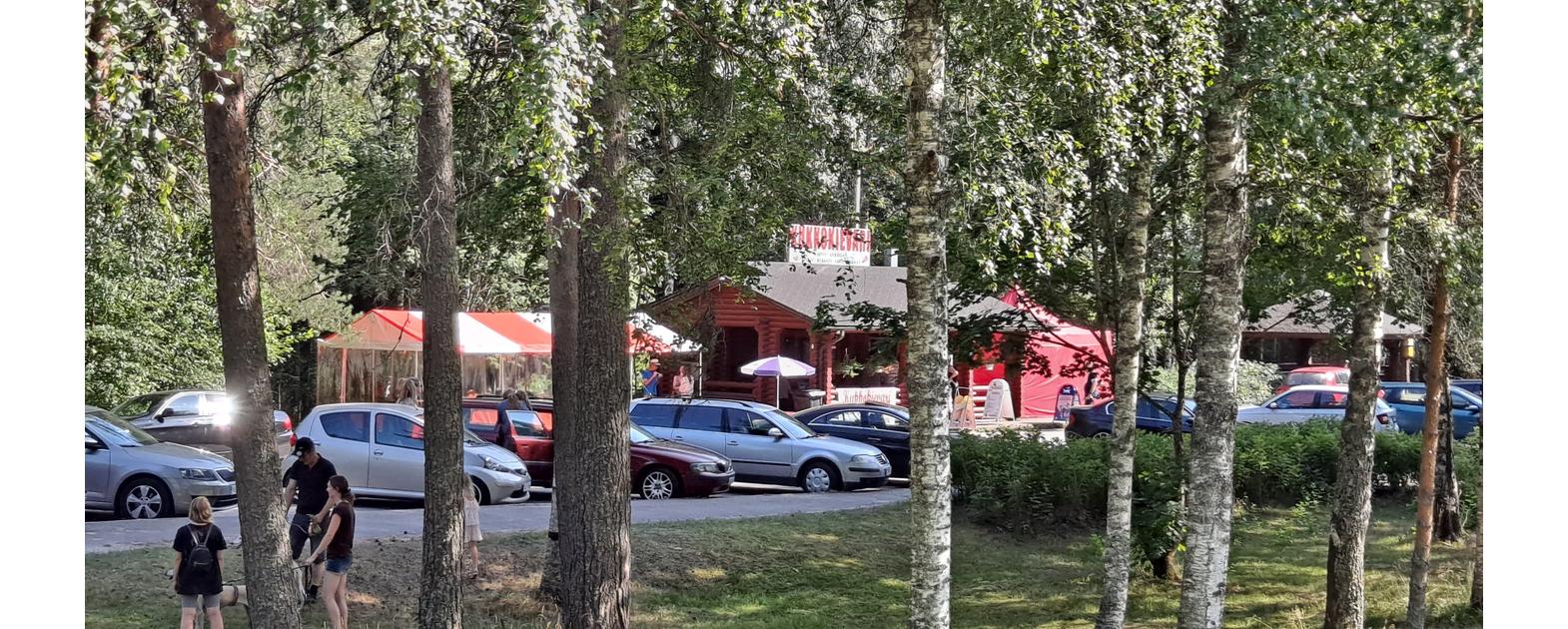
In Parikkala, a local food store with its produce has become established next to Highway 6, but next to it, at the Sculpture Park's rest area, the territorial conquest of Savonia's and perhaps Finland's most famous kalakukko vendor has caused wonder for a second summer. Kalakukkos are probably brought from North Karelia as well.
What's wrong with that, good entrepreneurial spirit and food. But being in old kalakukko regions here too, one cannot help but feel great dismay that we ourselves have not managed to fill the parking lots with local products and recipe ideas, even right next to the most popular attraction.
It strongly appears that, at least in Parikkala, the last few decades were more upward-trending in local product development than now. In addition to kalakukkos, honey mustards, sauerkraut, linen bread, and torn rye bread halves have also gradually and quietly disappeared. Salmon has not swum into containers for ages, and the long-renowned robber roast evenings in the northern part are now just a memory.
What could be done? There is, of course, no easy answer, as is always the case in food entrepreneurship, or entrepreneurship in general. The entire process would require a complete overhaul, starting from background research on edibles and the basic idea, continuing to product development, production investments, marketing... and so on.
It is also not easy to package all that is past: if someone succeeds in commercializing Parikkala's traditional pork stew, complete with all its innards, and making it suitable for modern palates, and even for takeaway, they might as well go straight to India to become a fakir. Of course, opportunities for the soup are still hoped for. Ones that, for example, many visitors to the Honkakylä trade museum still remember.
The basis for new food tourism can be not only the locality's food tradition but also an older, broader regional starting point, here especially Eastern Finland, the Karelian and Savonian-Karelian heritage. Opportunities naturally take shape based on primary production and through cooperation chains. Quite often, the composition of a local product is a manufacturing process recycled between neighboring provinces, if not an assembly from even further afield. There is still room for improvement here among those in the industry.
A local figure, a framing story, or an attraction can also fuel food perceptions. It has been quite some time since the maidens of Parikkala and the whitefish of Simpele were common topics. What would a maiden pack in her backpack now, perhaps a pike-perch tail? Would the lion's share from an elk or deer fall to Ruokolahti, and would an iron ration in Rautjärvi then consist of pudding, pea soup, and dark tea or chicory root? There is, of course, also an open-minded and unburdened perspective, where one can simply draw from the available natural offerings. Wild herbs have been popular everywhere. As many of our lakes are now eutrophic, for example, cattails are available in abundance. From it, nourishing flour can be obtained, which was utilized already in the Stone Age. Himalayan balsam and some lupines are also well suited for human consumption. So, four-H clubs, horsetail and roadside foragers, and cooking courses – and bon appétit!
-Rajamaisteri